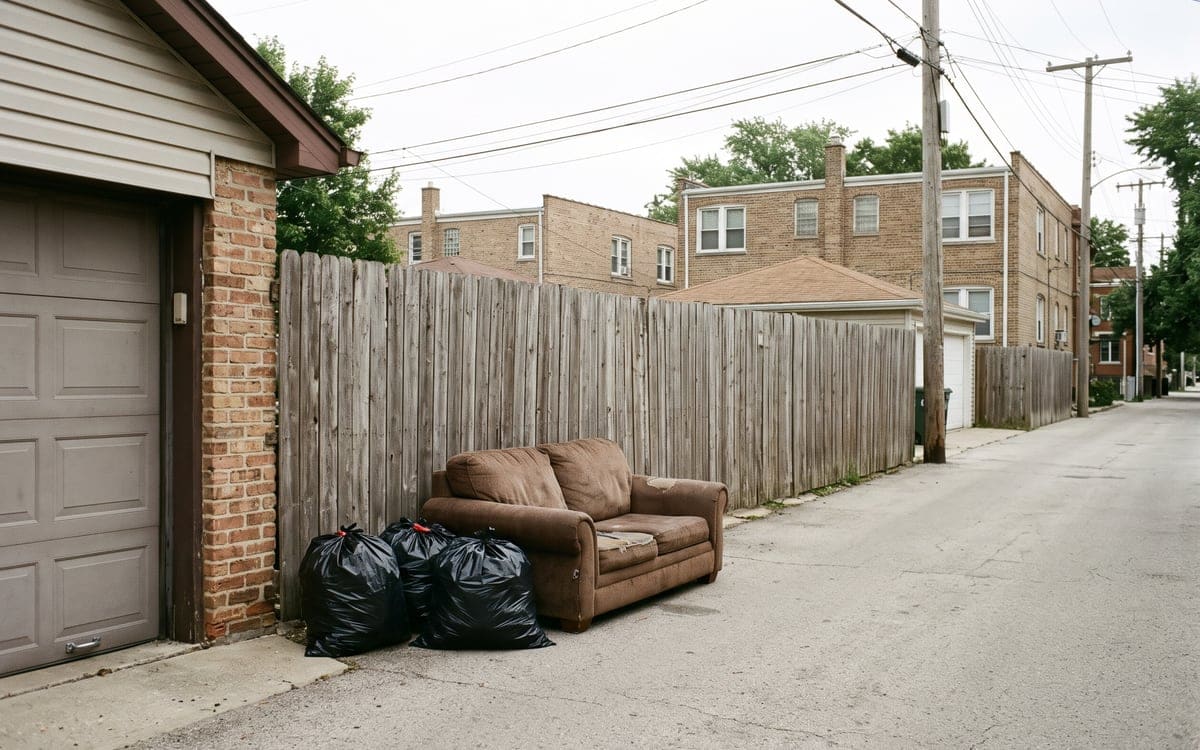
311 hears about fly dumping in Chicago thousands of times a year
Chicago's open 311 dataset logged 15,402 fly dumping complaints in 2025.1
The complaints come from residents who open a gate and find a load that was not there yesterday. The pile might be a mattress leaning against a garage or bags of plaster and tile from a kitchen that was redone three doors down and sent its waste the wrong way. The person who files the 311 report is often not the person whose things ended up there.
The code bans dumping anywhere but a permitted facility
The complaints exist because the practice is against the rules. Municipal Code 7-28-440 says no person shall dump, deposit, or dispose, or cause, suffer, allow, or procure to be dumped, deposited, or disposed on any lot or parcel of real estate within the city any ashes, refuse, or waste, except at a sanitary landfill site, liquid waste handling facility or transfer station for which a permit has been properly issued pursuant to the provisions of Chapter 11-4 of this Code, and declares such dumping a nuisance.2
The only lawful place for a load of refuse is a permitted facility, and the code calls dumping anywhere else a nuisance. Nobody you pay to take your things away is doing you a favor by dropping them in an alley.
Licensed haulers keep proof of where loads went
The flip side of the dumping ban is the trail a licensed hauler has to leave. Code 4-6-1503 requires licensed junk peddlers to take loads to City-permitted facilities and to keep records proving the disposal. The guide on checking a Chicago hauler lays out that section in full.
The lawful route is a round trip to a permitted site with the paperwork at the other end. Ask any hauler on the phone which permitted sites it uses and whether it holds the paperwork the code calls for.
A price far below everyone else's is a question worth asking
Permitted disposal costs money. A permitted site charges by the ton, the trip burns fuel, and the hauler has to spend time on the drive.
The spread in fair quotes on a given job is wide enough already. Ask the hauler, out loud, where the load goes, and listen for the answer. A hauler running the right way can name a permitted site without hesitating. The post on how a Chicago junk removal price is built covers what belongs inside the quote.
Listen for a permitted site named plainly, along with which City license the hauler holds.
The truck itself tells you something
Section 4-6-150 says the licensed hauler must display on each side and the rear of every junk vehicle, in letters not less than two inches in height and in contrasting color, the licensee's name, business telephone number and city junk peddler license number.3 Three readable pieces of information: a name, a phone, a license number. The guide on checking a Chicago hauler walks through what the two licenses look like side by side.
A truck with none of the three on it has already answered one question for you. The code describes a different kind of vehicle. The private scavenger side of the code also requires a City Clerk plate marked "Chicago Private Scavenger" on the vehicle, which is a different sign to look for.
Your own things belong in a cart, a crew's truck or a drop-off
Residents dump too. Chicago alleys collect loads from homes beside the loads from bad haulers. The ban in 7-28-440 is written broadly enough to reach a resident who sets a split sectional out beside a shared dumpster and hopes it disappears.
The lawful routes for a Chicago homeowner or renter come down to a short list.
| Where the load should go | What that means |
|---|---|
| The garbage service that already serves your building | For bagged household trash; ask the building owner or manager what the service takes |
| A hauler's truck with license, name and phone on the side | For furniture, appliances, cleanouts and larger loads |
| A permitted drop-off you take it to yourself | For the household materials the City's facility accepts from Chicago residents |
| A reuse group that said yes before you brought it | For pieces still in shape to be used by someone else |
The alley does not belong on the list. A couch on the pavement behind a two-flat is the kind of report that reaches 311.
What to do with the things the crew will not take
A crew leaves some things behind on purpose, and those have their own routes. Paint, household chemicals, fuel, propane and solvents usually need special disposal, and the chemicals a crew cannot carry are not alley material either. A can of leftover paint tucked beside a dumpster is the same complaint under the code as a dumped couch, with the added weight of a liquid that can leak into pavement and storm drains. Electronics are a case of their own, and the electronics recycling guide covers where they go. Dumping any of that in a bag or a bin has not avoided the ban, only moved it one more link down the chain.
Mattresses are a case of their own because they are hard to reuse and bulky to haul. Reuse groups set their own rules on used mattresses. The guide on where a Chicago mattress ends up says why a mattress in the alley is dumping, not a donation.
Big loads that look right in a crew's truck
A full remodel can run to several truckloads of heavy, awkward waste: drywall, tile, baseboard with nails in it, broken window frames, hunks of countertop. A crew is one route for the load, a rented dumpster the other. The page on construction debris removal in Chicago covers how the load moves.
Smaller loads of trash from a cleanout can look just as tempting to leave by the dumpster of a nearby building. They should not. A crew truck or a drop-off is the right destination for the last bags of a move-out, and the page on one-time trash loads covers what a trip for that kind of job looks like. The same goes for a couch after a sofa is replaced; furniture pickup is the clean route out.
What to ask before the truck leaves
| Warning sign | Why it matters | What to ask |
|---|---|---|
| No license number on the truck | The code requires two-inch lettering on each side and the rear | What is your license number, and what does the lettering look like? |
| No name or phone on the truck | Same section of the code | Why is your truck unmarked? |
| A quote that undercuts everyone else | A dump fee has to live somewhere | Does the price include disposal at a permitted site? |
| No answer on where loads go | The code says permitted sites, with records kept | Which permitted sites do you use? |
| Reluctance to say what the price covers | A clear quote names what is in and what is extra | What does the quoted price include, and what counts as a line beyond it? |
If one hauler stalls on any of these questions or pivots to a different one, call the next and run through the same list. The conversation is short either way, and the second call usually clears up the first.