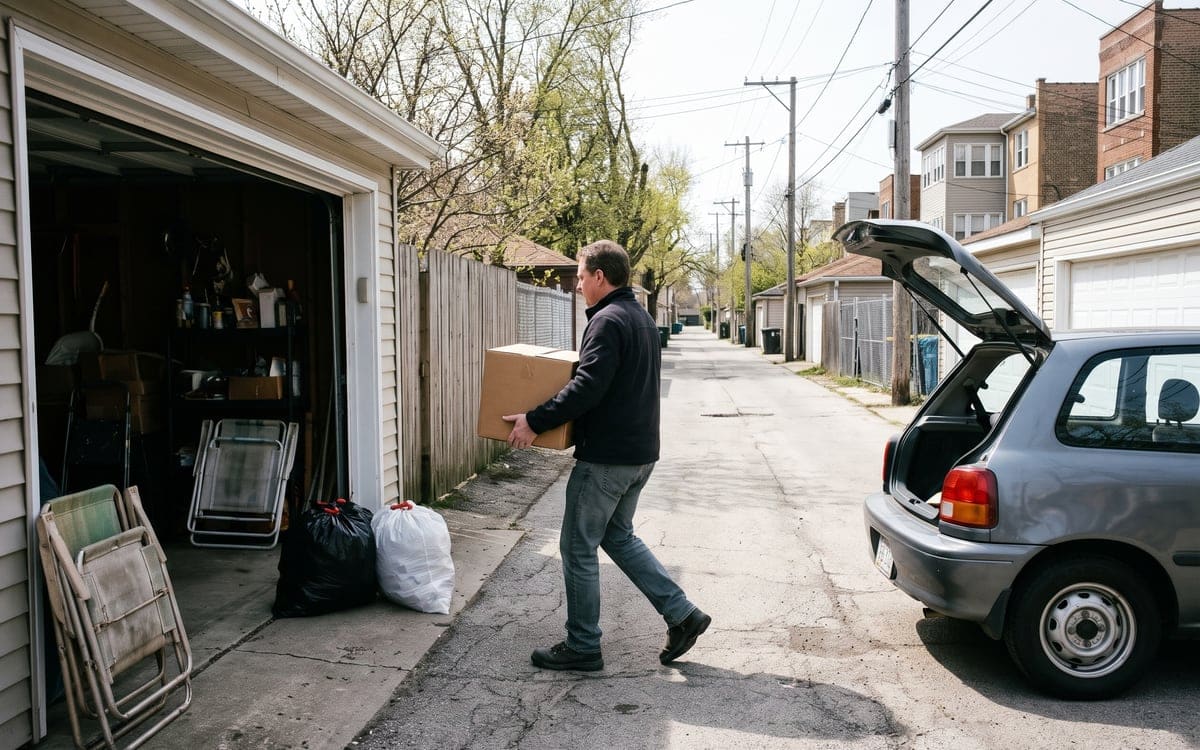
Bags, boxes and light pieces are fair game
A big share of what piles up in a Chicago basement is not heavy. Boxes of papers, bags of clothes nobody wears, a lamp with a broken shade, a plastic storage bin that cracked. Most of that is light enough to lift once. Ask the building owner or manager what its garbage and recycling service takes. The guide on where to dispose of leftover paint covers the one category of light things that does not belong in household trash.
The sane version of "haul it yourself" starts here, with the pieces that are not going to hurt anyone. A pair of trips to the cart on a quiet morning handles a surprising amount of a cleanout.
Stairs are where Chicago carries go wrong
Chicago has a lot of old buildings. 495,715 of Chicago's 1,277,054 housing units, about 39 percent, were built in 1939 or earlier.1 A couch coming down from three has a tight landing and a short banister rail to clear.
The piece shifts on the stairs, the carrier below absorbs more weight than planned, a knee gives. One person cannot steer a dresser down a flight. Two people without pads catch the walls on every landing.
Furniture and appliances on stairs belong with a crew. The page on furniture and couch removal in Chicago covers the carry on sofas, sectionals, bed frames and dressers.
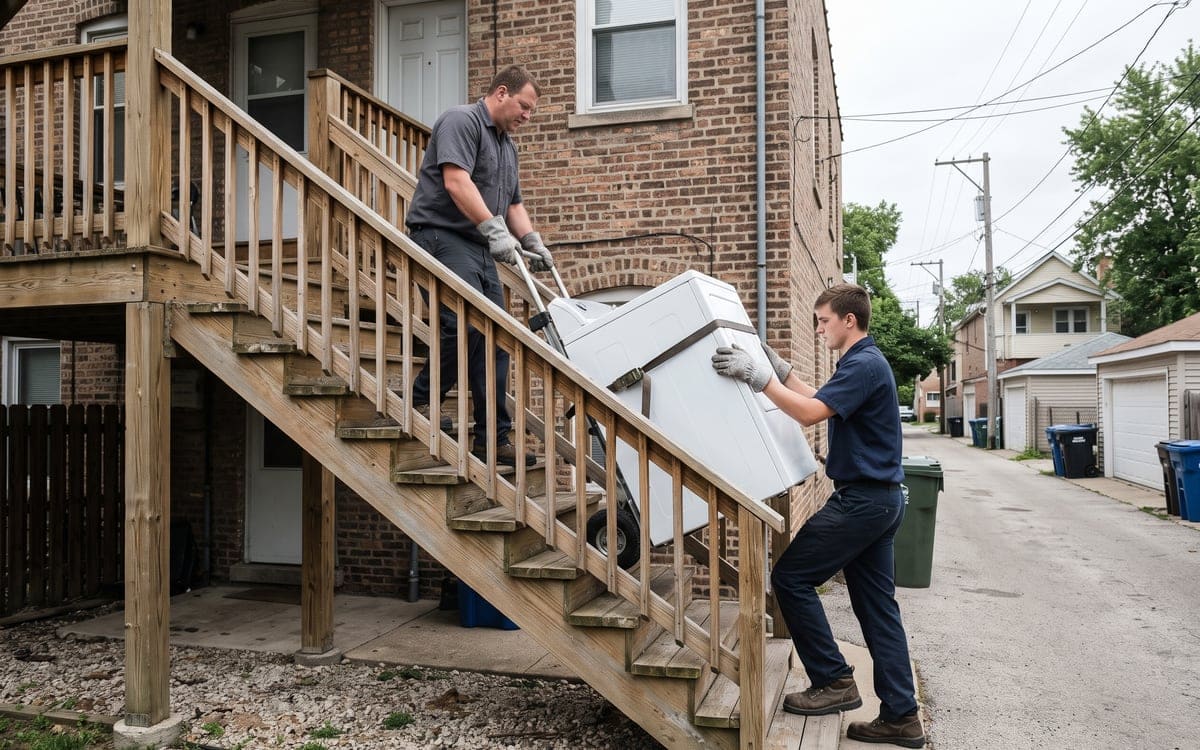
Refrigerators and washers are not one-person jobs
Appliances tilt into their own category. A refrigerator weighs enough to injure a person on the flat, and more on stairs. Never tip, drain or cut into a refrigerator, a freezer or a window air conditioner. The refrigerant inside is a trade step at disposal, not a resident one.
A washer or dryer is lighter than a refrigerator and still heavier than most residents want to find out about on a stairwell. Call a plumber, an electrician or the gas company to disconnect the live side before anything is pulled. A gas dryer needs the gas line capped by a qualified tradesperson before the dryer leaves the laundry room. An electric unit sits on a 240-volt circuit; the electrician throws the breaker and makes the circuit safe before anything is pulled. The page on appliance removal in Chicago covers how a crew handles the full set, from the condo kitchen to the two-flat basement.
Paint and chemicals have their own drop-off
A cleanout always surfaces things that do not belong in the regular trash. The City runs a household chemicals facility that accepts household chemicals such as bleach, harsh cleaning materials and drain cleaners, along with oil-based paints, solvents, CFL bulbs, batteries, aerosol cans and mercury items2 from Chicago residents.
The facility is for Chicago residents, not for haulers acting on your behalf: the City says all Chicagoans are welcome to drop off their individual household chemicals and electronics at the HCCRF, and that businesses and large groups must work with a private disposal company to have these materials properly disposed of.2 So a resident doing their own haul can take their own chemicals there. A crew cannot take yours there for you.
Latex paint is a case of its own. The paint disposal guide covers how the City says to handle it.
Check the facility's current schedule on the City's page before you drive over; the hours and the day-of status have been in flux.
Electronics cannot go in the trash
Illinois settled the question about old TVs and computers more than a decade ago. Since January 1, 2012, Illinois law has barred people from putting computers, monitors, TVs and many other electronics in regular trash, and landfills may not accept them; they must go to a registered recycler.3 The ban covers the box in the basement and the small desktop upstairs. The guide on how electronics recycling works in Chicago now covers where a resident can take an old TV or printer today.
Televisions on the "haul it yourself" list are headed to a recycler. A resident can take them. If a crew advertises taking yours, ask which registered recycler it uses.
Boxing broken glass and nails
The sharp parts of a cleanout have a special way of ending a job. A sheet of broken window glass or a stack of pulled tile cuts through a trash bag the first time it is lifted. Nails and tack strip from a carpet pull turn the bag into a trap for anyone else who touches it.
Boxing is the right handling, in a sturdy cardboard carton lined with another empty one and taped shut. Never handle broken glass bare-handed, and never pick through a box of sharps to pack it tighter. On the lift, carry the box flat-handed from underneath; keep fingers away from the top.
Larger sharps from a remodel, like broken tile, baseboard with nails and strips of metal roofing, belong with a crew. A box the resident put together on a Saturday morning works for one broken window; a kitchen's worth of smashed subway tile is a different problem, and the carry is heavier. The page on construction debris removal covers the full load.
Winter adds ice to every step
Chicago nights spend a lot of the year below freezing. At O'Hare, 1991 to 2020 normals show 121.3 days a year with a low of 32 degrees or colder, and 43.4 days when the high stays at or below freezing.4 A self-haul plan drawn up in the fall has a long window of frozen stairs to work around.
Icy steps and stairs with a load belong with a crew. Clear the path and salt the walk yourself, and leave the heavy pieces for the crew.
The alley is not a drop-off
The temptation on a self-haul is to leave the leftover pile by the dumpster of a nearby building. The City's dumping ban rules it out. Municipal Code 7-28-440 says no person shall dump, deposit, or dispose, or cause, suffer, allow, or procure to be dumped, on any lot or parcel of real estate within the city any ashes, refuse, or waste, except at a sanitary landfill site, liquid waste handling facility or transfer station for which a permit has been properly issued, and declares such dumping a nuisance.5
The lawful routes for the leftover pile are the building's garbage service for what fits, a drop-off you can take yourself to, or a crew truck. The alley by the dumpster of the three-flat down the block is none of those.
When the math favors a crew
Some jobs look like a self-haul on the sheet and turn into a crew job on the day. A short list of them.
| Job | Do it yourself? | Why |
|---|---|---|
| Bags of pantry overflow | Yes | Ask the building owner or manager what the garbage service takes |
| A single kitchen chair | Yes | Light enough for a short carry |
| A full-size sofa off a third-floor walk-up | No | Weight plus stairs plus turn |
| An old refrigerator in the basement | No | Weight and refrigerant make it a crew job |
| Half a can of latex paint | Yes | See the paint disposal guide |
| A boxed-up TV and a dead desktop | Yes | Take to a registered electronics recycler |
| A split sectional in two pieces | No | Each piece is still heavy on stairs |
| An upright piano | No | A piano is a piano; see piano removal |
| A hot tub on the back deck | No | Heavy, with power still live; see hot tub removal |
| Three bags of broken tile | Mostly no | Weight and sharps together |
| A truckload after a remodel | No | Weight and volume both argue for a crew |
The post on what a Chicago junk removal price covers walks through what a crew quote should include so you can weigh the trade for yourself.