
How we size up a remodel debris load
Remodeling debris weighs more and cuts worse than regular trash, so the walk-through runs a different checklist.
1. What the debris is
The median year built for Chicago housing is 1953,1 and about 39 percent of the housing stock was built in 1939 or earlier.2 Tile, mortar, old cabinets, flooring, lumber with nails and the ragged edge of a tub surround round out most jobs. Say on the call what the pile is: drywall or plaster, broken tile, lumber with nails, concrete pieces, a mix.
2. Weight
Weight is one driver on a debris load. Concrete, brick, tile and plaster are dense; a wheelbarrow of plaster can weigh as much as a full couch. On the first call, say what the dense material is (plaster from a gut, broken tile from a bathroom, a torn-out concrete step) so the quote lines up with the pile.
3. Suspected asbestos
Pipe insulation, old floor tile, some mastic adhesives and plenty of other older building materials can contain asbestos. We do not remove suspected asbestos. If the walk-through turns up anything that reads old enough and odd enough to be a question, the pile waits where it is, undisturbed, while a lab tests it and an abatement contractor handles that material. The crew does not touch it or set it apart; a mixed pile with suspect material in it waits for the test too.
4. Sharp debris and nails
Nails in lumber, broken tile, cracked glass, torn metal strap: these go in boxes or bags, not loose in a pile. No one picks through nails bare-handed and you do not have to sort it. If a bin is already there, the crew loads it and rides it to the truck.
5. Where it sits
Inside, in the garage, in the yard, by the alley. Inside means stairs and a route through the house. The garage is the simplest load. A yard pile works well if the alley access takes the truck; a front-yard pile means a long carry and sometimes a parking plan on the street. Say which it is on the call, and whether there is a gate between the pile and the truck.
6. Who is responsible for the debris
The City says residents who remodel are responsible for removing discarded building materials, and that dumpsters can be rented for it.3 A hauling crew is one way, a rented dumpster is another.
| Item or situation | What the crew checks | What to say on the call |
|---|---|---|
| Drywall and plaster | Age of the building, pieces or dust, sharp edges | Whether the pile is drywall, plaster, or a mix |
| Tile and mortar | Weight, sharp edges, backer board | How many square feet of tile, and whether the backer board is on it |
| Old cabinets and countertops | Frames, countertop material, screws | Whether the cabinets are already off the wall, and the countertop material |
| Lumber with nails | Length, nail density, splinters | Rough length of the longest pieces and whether the nails are still in |
| Concrete or brick | Size, pieces, where it sits | How much is in the pile, and whether it is broken into pieces |
| Carpet and pad | Rolled or still down, staples, tack strip | How many rooms, and whether the carpet is rolled or still down |
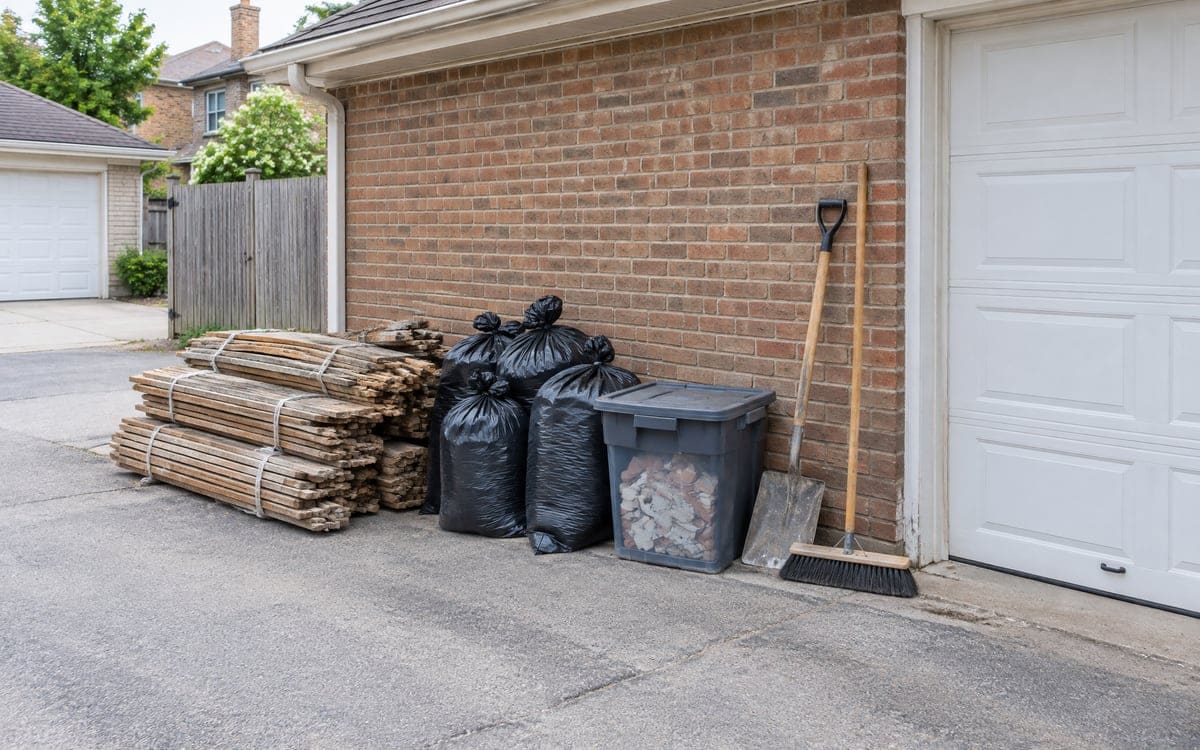
Related jobs on a remodel: carpet and pad coming out as part of the floor change, the old kitchen appliances coming out at the same time, a deck torn out at the back of the house, or the bags from the job that are not construction debris and should ride in a different load.
What can be reused and what has to go
Most of a debris pile is disposal, with a short list sometimes worth pulling out of it.
Sometimes worth setting apart
- Cabinets still in one piece, with doors and hinges
- Full lengths of lumber in good shape, no rot
- Clean brick or paver stone, no mortar on it
- Doors and trim that are not painted shut
Debris that goes
- Drywall and plaster, broken or whole
- Tile, mortar and backer board
- Lumber with nails, split pieces, water-damaged wood
- Countertops with the sink hole already cut
The crew flags what is worth saving at the door; the rest goes in the truck. We make no promise about where a load ends up; what to ask any hauler is in the guide to hiring a junk removal company.
What our crew handles on a debris job
Bagging loose debris, boxing sharp pieces, carrying from the room to the truck, and loading the truck. Dust control on an active job is up to the contractor; what we handle is the pile already made. The crew does not pull cabinets off the wall, cut tile out of a floor, pull pipe or do any part of the demolition itself. The pile is already there when the truck arrives.
The City expects whoever remodels to arrange where the debris goes.