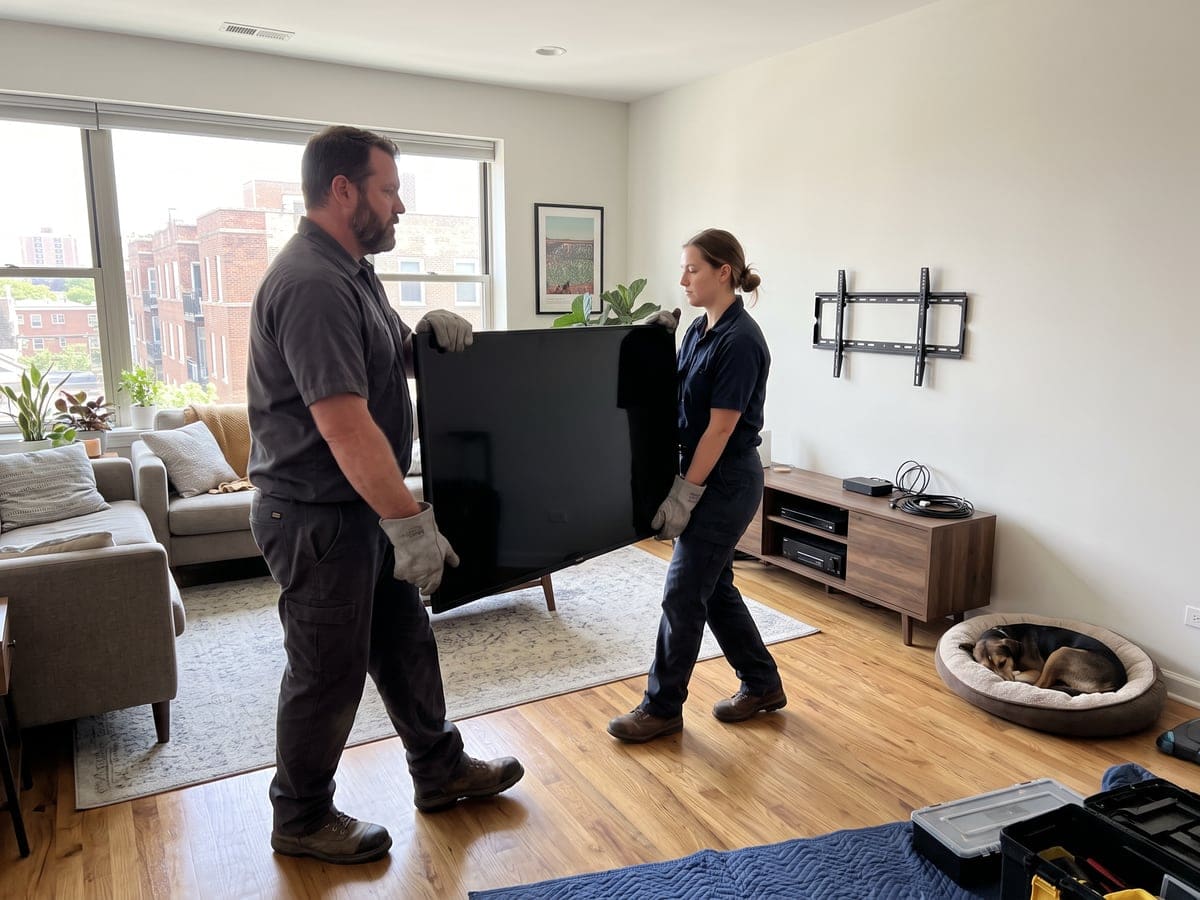
Which TV is this?
The crew looks at a few things on every TV pickup, because a tube set and a flat screen behave differently in the hands.
1. What kind of set
A tube television carries thick glass and a lot of weight. A rear-projection set is bulky and awkward on stairs. Flat screens are lighter but fragile, especially at the panel. Say on the call which the set is, and the rough screen size.
2. Wall mounts
If the TV is on a mount, the crew lifts it off the mount. The mount itself and the holes in the wall are not part of this job; we take the TV. Patching the wall and taking the mount off are a different trade.
3. Computers, monitors and printers
A tower, a laptop, a monitor and a printer all count as electronics under Illinois rules and ride with the TV in the truck. The crew takes keyboards, mice, speakers, and the box of cables under the desk. A full office of monitors can be part of an office furniture removal job.
4. Your data
Wipe or remove your own data before the crew comes. Pull the hard drive out of a desktop if you prefer, or run a secure wipe from the operating system. The crew does not handle, wipe or escrow data, and nobody opens the case on your behalf. For a laptop, remove it from an account and factory-reset it; for a desktop, the drive is the only part that holds personal data.
5. Where it sits
A tube TV at the top of basement stairs, a projection set in a finished basement, a flat screen in a third-floor apartment: each one changes the carry. Say on the call which floor the set is on and whether the stairs are inside the home or outside it.
6. Why electronics cannot go in the trash
Since January 1, 2012, Illinois law has barred people from putting computers, monitors, TVs and many other electronics in regular trash,1 and landfills may not accept them. Everything on that list goes to a registered recycler. The City's monthly e-waste drop-offs are on hold until further notice.2 The Department of Environment points residents to the Household Chemicals and Computer Recycling Facility at 1150 N. North Branch Street,3 which takes residential electronics from Chicagoans only;3 businesses must use a private disposal company. The facility has posted repair notices, so check before you go.
| Item or situation | What the crew checks | What to say on the call |
|---|---|---|
| Tube TV | Weight, path width, stand attached or loose | That it is a tube set, and the rough screen size and floor |
| Flat screen on a stand | Stand screws, cable loose from the back | Flat screen, with or without the stand |
| Wall-mounted TV | Mount type, lifted off safely | That it is on a wall mount, and the mount stays |
| Projection TV | Weight, screen glass, stand | That it is a projection set, with the screen size |
| Desktop and monitor | Drive removed or wiped by the owner before the crew comes | How many towers and monitors, and that the data is already handled |
| Printer or copier | Toner installed, paper trays loose | Whether it is a desktop printer or a floor-standing copier |
When an electronic has a second life
- Newer and working flat screens
- Laptops and desktops that boot
- Monitors that light up with no dead pixels
- Printers that still work, with original parts
When it is done
- Any tube or projection TV
- A flat screen with a cracked panel
- A desktop that will not start
- An old printer with no parts available
Pieces with a chance may be offered for reuse. Illinois bars TVs, computers and monitors from the trash, and the items must go to a registered recycler.1 Ask any hauler where its loads go.
What the crew handles on the day
Carrying each piece out and loading the truck are part of the job. A flat screen rides upright with the panel supported. Keyboards, mice and the box of cables under the desk ride with the tower. A desktop tower with the drive still in it goes the same way; the owner has handled or removed the drive before the crew arrives.
The pieces leave the home as they stood on the desk, as items of hardware. Patching a wall, pulling a mount off, cutting into cabinetry around a built-in set and running new cable are not part of this job; those sit with a different trade.
From the first call to the loaded truck
- You call (312) 847-2454 and tell us what kind of set, how many pieces, and where in the building they sit.
- On the day, the crew looks at the TV, the path out, the stairs and the alley.
- The crew carries each piece out and loads the truck.
Chicago, the trash cart and the registered recycler
The Chicago trash cart is not an exception to the 2012 ban. For residents who want to handle it themselves, the Household Chemicals and Computer Recycling Facility3 at 1150 N. North Branch Street takes residential electronics from Chicagoans. A heavy tube set is not a job to do alone, so a resident dropping one off should not try to lift it alone. If a drop-off is not an option, the crew comes to the house.
Businesses must use a private disposal company for their own electronics, so a store, an office or a landlord clearing a unit of someone else's electronics takes a different route. Ask any hauler where its electronics go, since the Illinois rule applies to the hauler as well as the resident.
An old window air conditioner stacked next to the TV is a separate rule under appliance disposal. A basement full of boxed electronics can ride out as part of a cleanout. For a one-off drop-off plan rather than a pickup, the electronics recycling guide walks through the options, and why hauling a tube TV alone is a bad idea sits on its own guide. The guide links the City pages for the drop-off and the rule.