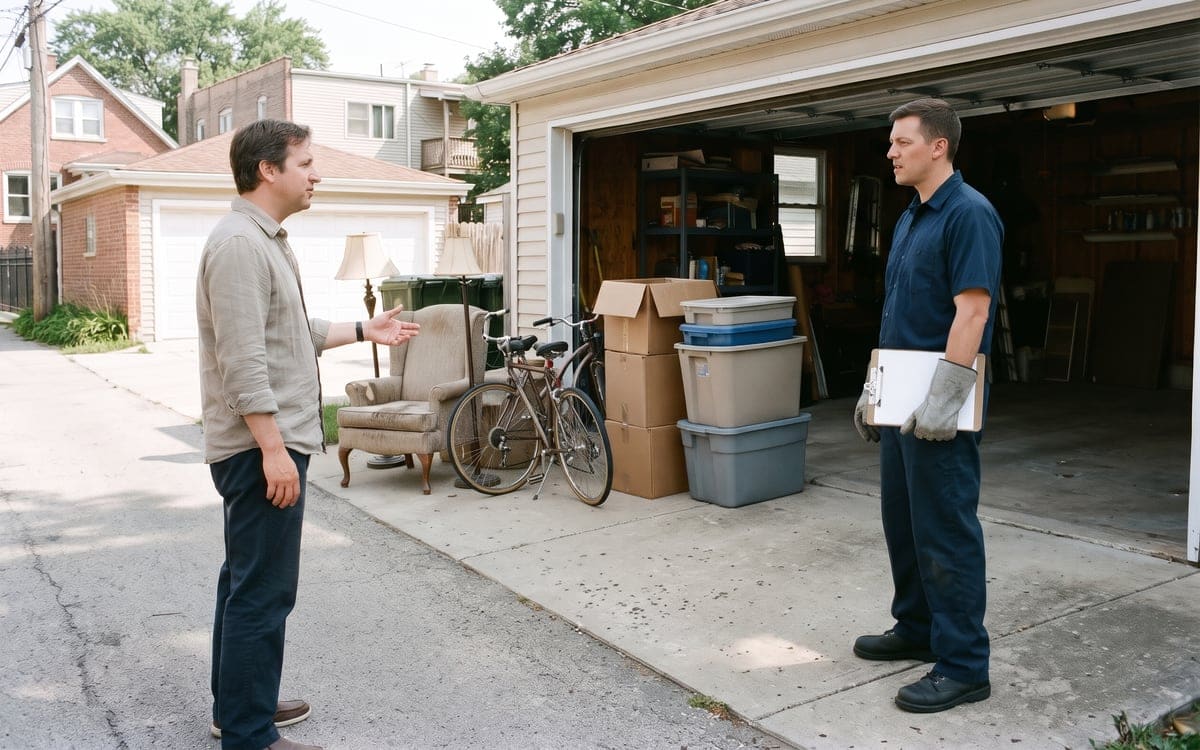
The City licenses junk haulers
Chicago's Municipal Code 4-6-150 defines a junk peddler as anyone who travels, with or without a vehicle, from place to place in the city to collect, transport or dispose of junk.1 Paid junk hauling fits inside that definition. The license is issued through the City's licensing office.
If the people pulling up to your alley are collecting things to haul away for pay, the City expects them to hold a license for it.
The code's word for junk is wide
The same section's definition of junk1 covers scrap metal, old rope, rags, paper, wastepaper, used building materials, and everything else discarded or no longer in use. If you are paying someone to take it away, the code probably counts it.
A hauler cannot shrug off the license by saying your things are not really junk. The definition is written to catch almost everything a homeowner would put at the curb.
A licensed truck tells on itself
The lettering on the side of the truck is the easiest thing to check from the sidewalk. The code says a licensed junk peddler must display on each side and the rear of every junk vehicle, in letters not less than two inches in height and in contrasting color, the licensee's name, business telephone number and city junk peddler license number.1
The truck is supposed to carry three readable pieces of information: a name, a phone number and a license number. A plain white box truck with nothing on the side is not what the code describes. Neither is a pickup with a hand-painted logo and no license number anywhere.
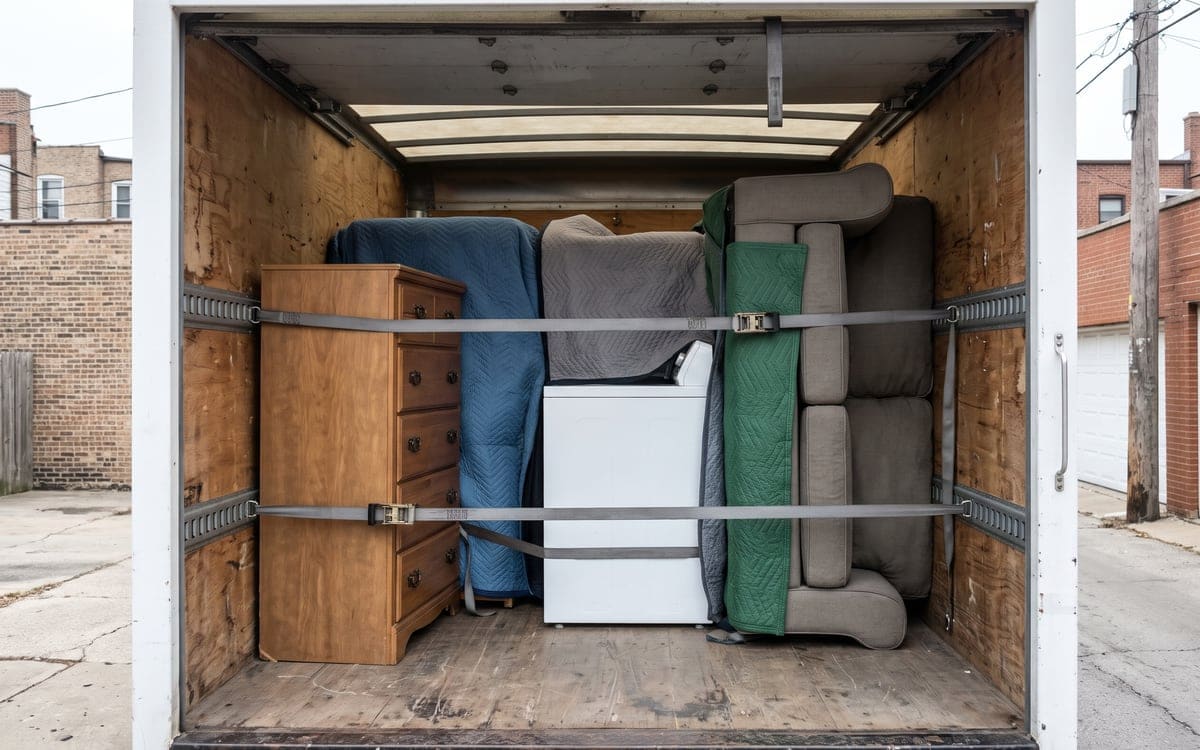
The load has to go to a permitted facility
A hauler cannot just drive your load off and dump it somewhere out of sight. The code says a licensed junk peddler must lawfully dispose of junk by hauling or otherwise bringing junk to a junk facility, recycling facility, transfer station, landfill or other solid waste disposal facility properly permitted by the city, and keep and maintain, in the form of records and receipts, proof of proper disposal of junk.1
The load goes somewhere the City has permitted, and the hauler keeps paperwork proving it. Ask any hauler which permitted sites it uses and whether it holds the paperwork the code calls for.
Construction debris falls under a second license
The code has another license for haulers of a different sort. Section 4-6-130 defines a private scavenger as anyone engaged in the removal and disposal of recyclable material, construction and demolition debris, grease, fats and oils, table refuse, animal or vegetative matter usually known as garbage, or other wastes from premises where the City does not provide that removal.2 The scavenger license is separate from the junk peddler one, with its own vehicle rules: each private scavenger truck has to carry a City Clerk plate marked "Chicago Private Scavenger" and pass a Streets and Sanitation inspection.2
Which license applies to a given junk removal company is the City's call. Both exist, the definitions overlap in places, and the City's licensing office answers which one applies to a given business. The practical answer for you: ask any hauler which City license it holds for the work it does, and look for the matching lettering or plate on the truck.
Every business in Chicago needs a City license of some kind
Beyond the trade-specific licenses, Chicago's licensing office writes that a Chicago business license is required to conduct, engage in, maintain, operate, or manage any business in the City of Chicago, with limited exemptions mainly for state-licensed professions.3 The code backs that up: it is unlawful for any person to operate any business for which a City of Chicago license is required without first having obtained the required license, and each location at which a business operates must be separately licensed.4
For any junk removal company, the question is which license applies. Ask any hauler on the phone which City license it holds.
Dumping is banned, and 311 hears about it
Section 7-28-440 bars dumping any load of refuse on any lot in the city except at a permitted landfill, liquid waste facility or transfer station,5 and declares such dumping a nuisance.
Chicago's 311 system logged 15,402 fly dumping complaints in 2025.6 The guide on what fly dumping actually looks like in Chicago walks through the warning signs on the hauler side.
A price you can understand
A quote should be legible before anyone opens the truck. The things that make a Chicago job cost more are the same from one hauler to the next: the number and size of the pieces, the floor the pieces sit on, whether there are stairs or an elevator, and whether anything has to come apart to leave the room. A piano, a hot tub, a slate pool table or a heavy appliance from a basement are all drivers to name on the call. On a mixed job that includes a parent's home or a full move-out, there are more drivers to describe. The guide on what sets a junk removal price in Chicago breaks down the drivers in more detail.
Ask any hauler what the quoted price includes, and what counts as a line beyond it. A price far below everyone else in town is a question worth asking out loud: where is the load actually going, and does the quote cover a trip to a permitted site?
Questions to ask on the phone
A phone call is the right time to sort a licensed hauler from one hoping no one asks. The right questions do not need legal training.
| What to check | What the code says | What to ask |
|---|---|---|
| City license | A junk peddler or private scavenger license is required | Which license do you hold, and what is the number? |
| Truck lettering | Name, business phone and license number on each side and the rear, two-inch letters | What does the lettering on your truck look like? |
| Where the load goes | Permitted facilities only, with records kept | Which permitted sites do you use? |
| What the price covers | The code is silent on the quote | What does the quoted price include, and what counts as a line beyond it? |
| Proof of disposal | The code says records and proof of disposal are kept | Do you keep paperwork from the permitted sites you use? |
| Business license | Every business in Chicago needs a license | Do you also hold a Chicago business license? |
On a job that fits a single service, like a furniture pickup or a refrigerator or washer out of a basement, the same questions still apply. Ask them in whatever order feels natural on the phone.
What happens on our end after a call
On the call, say what has to go and where it sits in the home, which floor the pieces are on, and whether a truck can stop near the door or has to park at the alley. For a job that spans more than one trade, say which pieces fall where: furniture that is going because it does not fit the new place, appliances that are leaving as part of a kitchen refresh, bags and boxes left after the movers. Each category has a different route through the home, and naming them on the call shortens the back-and-forth later.