Most Chicagoans rent, and many have moved recently
The move-out question covers a big share of the city. Chicago has 1,160,205 occupied homes, and renters hold 626,193 of them, about 54 percent.1 Owners hold the other 46 percent, and both groups move. Of all Chicago households, about 30 percent (348,301) moved into their home in 2020 or later, with the figure closer to 42 percent among renters.2 Over the past twelve months, 86 percent of Chicagoans aged 1 and over lived in the same house a year earlier, so about 14 percent had moved.3
Sorting starts with what will not fit the new place
Walk the home with the floor plan of the new place in your head, since a dining table or a dresser that fit the old apartment may not fit the new one. The things that fit go on the moving truck. The things that do not go to a reuse group, to a hauler, or in whatever route the building's garbage service takes (ask the building about that one).
Sorting before the move cuts the pieces the mover charges to lift and set down. The guide on giving furniture away in Chicago covers what reuse groups will take and what they refuse. Pieces still in shape go there first, because a reuse group that already said yes is a shorter route than any hauler.
Garbage service depends on the size of the building
A move-out often has a stretch of days when the normal bins fill up. What the City picks up depends on which kind of building the move-out sits in.
City crews run weekly garbage collection to about 600,000 households in Chicago, in single-family homes and apartment buildings of four units or less; others must arrange private garbage collection.4 On the owner side, owners of apartment buildings must provide sufficient garbage containers for all tenants and arrange for private or licensed scavenger pick-up service.5
The practical question for a mover is whether the building has four units or less, or more. In a two-flat or a four-unit, City pickup is on the weekly schedule. In a six-unit, a thirty-unit or a high-rise, the owner has set up private collection, and the rules for what fits in the chute or the dock bin are the owner's. Ask the building what its garbage service takes before move day. On a mid-move Sunday, that is the difference between bagging the last of the kitchen and watching bags pile up in the hall.
Recycling follows the same line
Blue cart recycling is the mirror of the garbage picture. The City says if you are not in a one-to-four unit building serviced by the City of Chicago, please check with your building owner or property manager office for information on your collection schedule.6
Small buildings have the City blue cart. Larger buildings have whatever recycling the owner has set up, which in some buildings is single-stream pickup from a chute and in others is a cardboard bin by the loading dock. Ask the building before you lean three flattened cardboard towers against the wrong bin.
Big pieces and narrow stairs decide the plan
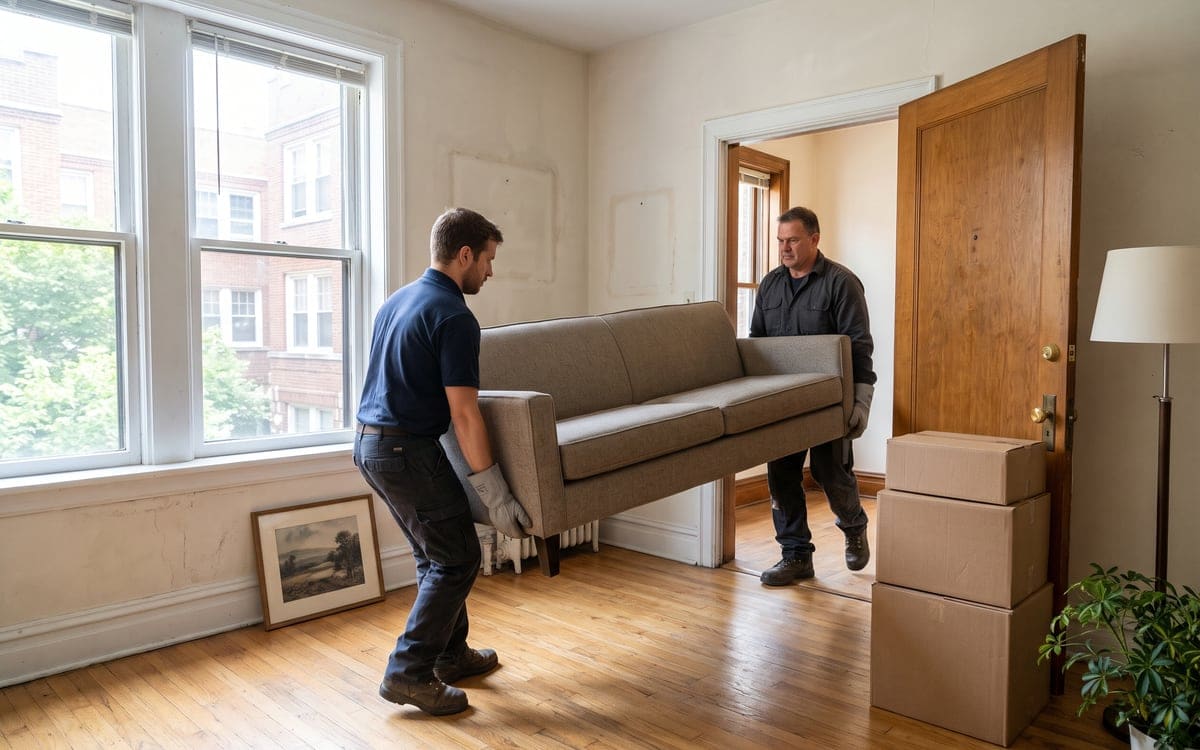
Chicago housing splits between a lot of small buildings and a lot of large ones. 260,274 Chicago housing units are in buildings of 50 or more units, and 43 percent of all units are in buildings of five or more.7 A larger building may have a service elevator, and the building sets its own rules for it, so ask the owner or manager before move day. A smaller building has a stairwell with one tight landing and a back porch with a flight running down to an alley garage.
The practical move-out question is which route the big pieces go through: the front stairs, the service elevator, the back porch. On a job that includes a sofa that will not make the turn or a sectional that has to come apart, furniture removal covers how the piece comes down. On a king mattress and box spring from a bedroom on three, mattress removal covers the bagging and the carry. A whole apartment at once goes to a house or apartment cleanout, where the crew runs the room-by-room order.
Measure a doorway with a tape before move day if a piece looks tight.
Winter moves bring snow into the picture
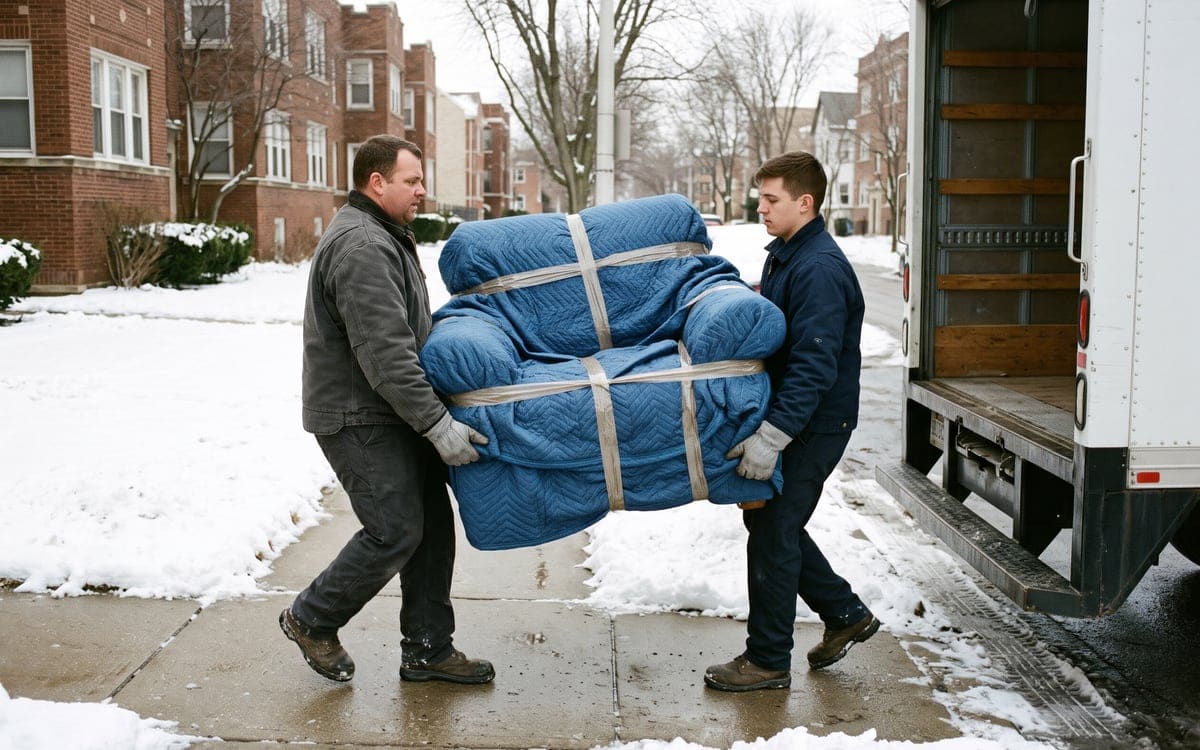
Chicago winters are real. The normal first measurable snowfall at O'Hare is November 18 and the normal last is April 2,8 so a move in those months carries the chance of a snowy walk, an icy porch step and a wet door frame.
A winter mover can help by shoveling the path to the alley or the curb and laying something on the floor inside the door. If the moving company is in one truck and a junk crew is in another, the two trucks are easier when the drive is clear.
What a landlord should know about things left behind
A unit does not always come back empty. When a tenant leaves bags, a mattress and a dresser behind, the question of what happens next is a legal question an attorney can walk a landlord through. The practical half is simpler: the stuff still has to go, and a crew can handle it.
For a unit that comes back with a full living room of things, the page on house and apartment cleanouts covers the pattern. The crew carries out what the tenant left.
What to leave for a crew and what to finish yourself
A move-out usually has a mix of what belongs with a hauler and what belongs with the mover or your own two hands.
| Item | Keep, give away or haul | Note |
|---|---|---|
| A sofa the new place has no room for | Give away if clean, haul if stained or torn | Reuse groups want to see photos before saying yes |
| An old mattress once the new one arrives | Haul | Bag it in the room so hallways stay clean |
| The dresser you have had since college | Keep, give away or haul | Weight and condition decide |
| Three bags of pantry overflow | Finish yourself with the building's garbage service | Ask the building what its service takes |
| A couch too big for the stairs | Haul with a crew | A crew carries, takes apart if needed |
| Boxes of papers and old files | Decide based on what is in them | Keep records you need; haul the rest |
| A broken shelf unit | Haul | Not a reuse candidate |
| Half a bag of leftover paint | Not a crew's load | Household chemicals have their own route |
You also handle the last clean of the kitchen, the floor around the fridge, and the bags of trash the new place does not want. That part belongs with the building's garbage service, in a one-time trash load with a crew, or in a trip you take yourself to a drop-off.
When the crew comes versus when the movers come
Tell us when the movers are coming. Some residents want the hauler before the movers so the apartment is pared down to what is going; others want the hauler after, when the leftover pile is clear. Either order is fine.
The one combination that gets tangled is both trucks on a narrow Chicago street at once. Movers in front of the door, haulers waiting behind. Say on the call where the movers are set to be and when.
Where the load does not belong
A loaded alley is where a mover's leftover pile tempts a tenant on the last day. Leaving things in the alley is not a disposal route; the guide on fly dumping in Chicago walks through what the complaint data looks like and why a load in the alley is a complaint waiting to be filed. The right routes are a hauler's truck, the building's garbage service for what fits, or a drop-off a resident takes themselves.