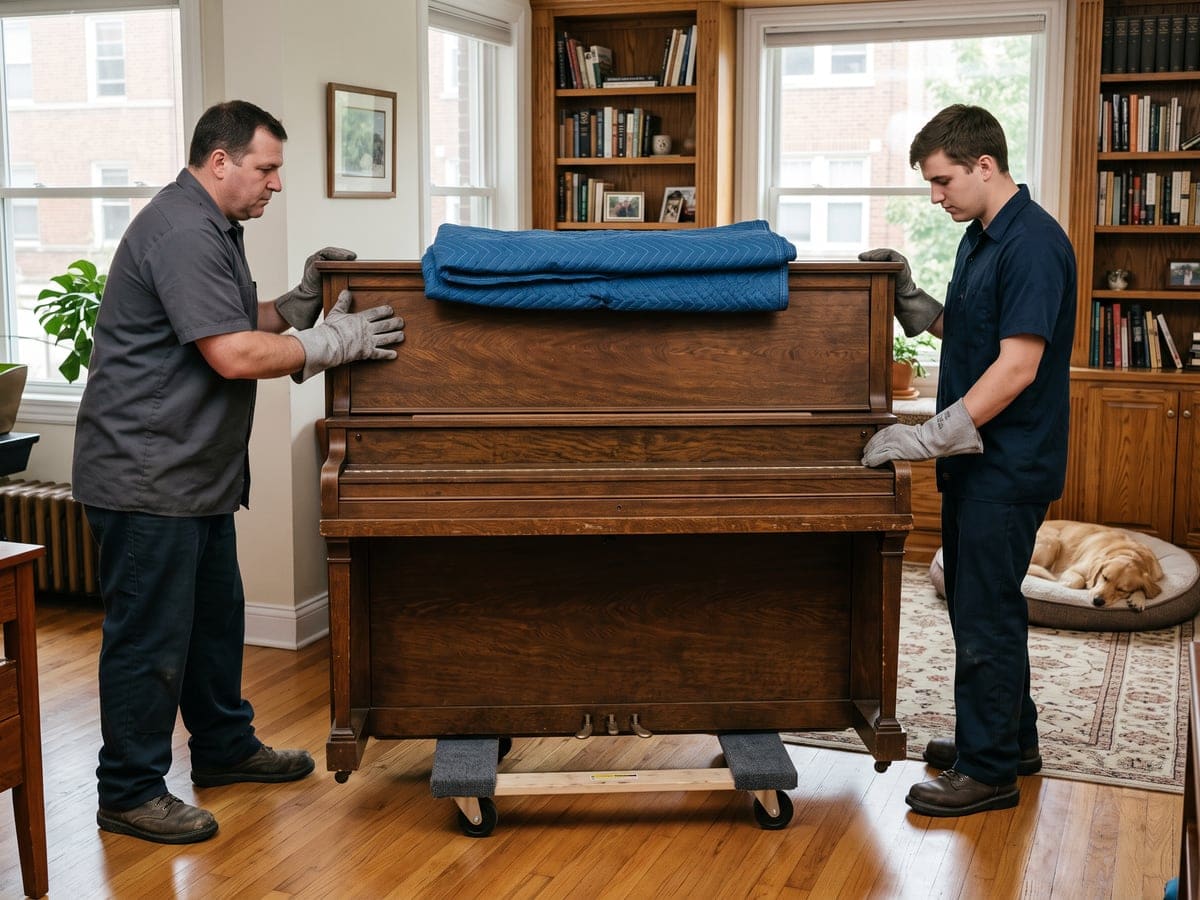
What kind of piano, and where does it sit?
Pianos are built differently from furniture. The frame is a cast-iron harp holding tens of thousands of pounds of string tension, the case is wood on top of that, and the whole assembly behaves badly on stairs if the carry is improvised. The crew looks at six things before any strap goes on.
1. What kind of piano this is
A spinet is the shortest upright and the lightest in the family. A console upright is a little taller and a little heavier. A studio upright steps up again, and a full upright is the biggest and heaviest of them. A player piano adds the roll mechanism inside the case, which puts extra weight into the front. A grand piano is a different animal entirely and gets handled as a question for the call, with no promise before the crew sees it.
2. Weight and the floor it sits on
A piano concentrates a lot of weight on three small casters. The crew looks at where the feet land, especially on a second-story floor in an older building. Rugs come up before the piano moves, so the casters are not fighting the carpet.
3. Stairs: how many, how many turns, inside or out
Stairs are what makes piano removal hard. A turn at the top, a landing in the middle, or a stairwell with no overhead clearance for a piano on end each changes how many people are needed. On the call, say the number of flights, whether there is a turn, and whether there is a landing between flights.
4. Doorways, porches and the front stoop
The width of the doorways between the piano and the sidewalk matters, and so does the front stoop. On the call, say what the front door looks like, whether there is a stoop between the door and the sidewalk, and whether the door opens into a hallway or straight into the room.
5. Whether anyone wants it
An old upright is hard to give away. A spinet in rough condition is usually done. A console in good shape with recent tuning and no cracked soundboard has a chance, and we can tell you at the look whether the piano looks worth offering.
6. Who is on the stairs
A piano on stairs needs several hands. The size of the piano, the staircase and the turns all matter. On the call, say which the piano is (spinet, console, studio, full upright, player or grand), so the crew can plan.

| Item or situation | What the crew checks | What to say on the call |
|---|---|---|
| Spinet | Casters, pedal clearance, bench | That it is a spinet, and the floor it sits on |
| Console | Weight, lyre, bench | That it is a console, and whether the bench stays or goes |
| Full upright | Floor, stairs, overhead clearance | That it is a full upright, and the number of flights to the sidewalk |
| Player piano | Roll mechanism, front weight | That it is a player piano (front-heavy from the roll mechanism) |
| Piano bench and stool | Hardware, hinge | Whether the bench or stool goes with the piano |
| Grand piano | Legs, lyre, lid, floor | That it is a grand, so the crew can size it up before any promise |
When an old piano has a second life
- A newer console or studio upright
- No cracked soundboard, no missing strings, no mouse damage
- Keys level, hammers whole, pedals working
- The owner can show recent tuning
- A path for it to leave the house in one piece
When it is done
- A spinet with cracked ribs or a broken plate
- Any piano with mouse damage inside the case
- Keys stuck, missing or stripped
- A soundboard with a long open crack
- Anything that has lived in a damp basement for years
A piano on that first list might find a next room, somewhere. The donation guide covers who takes used instruments in general and how to ask. Everything else goes out. We cannot promise where any one piano ends up.
Hands off the piano
Pianos are not a one-person job. The weight distribution is why this is a crew job and not a weekend favor; keep hands off the piano until the crew is at the door.
Roll up the rugs before the day so the casters are not fighting the carpet. The pedal lyre and the bench are the two pieces most likely to catch on the way out; leave the lyre as it is and put the bench to one side.
From the first call to an empty room
- You call (312) 847-2454 and tell us what kind of piano, where it sits, and what the stairs look like. If you know the brand on the plate and roughly how old the piano is, that helps.
- On the day, the crew looks at the piano, the floor, the stairs and the path to the truck.
- The crew carries the piano out and loads the truck.
Old Chicago homes and the pianos nobody plays
About 39 percent of Chicago's housing units were built in 1939 or earlier.1 About 27 percent of Chicago's housing units sit in two-, three- and four-unit buildings;2 a building with a front stoop and an inside staircase changes the plan again.
A piano can go with the rest of the room on the same truck. If the home is being cleared after a death or a move to care, the piano is on the list with everything else. If the owner is moving out of the house or the apartment, the piano goes once the family has decided what stays and what does not.
The front stoop on a two-flat, the inside staircase on a graystone, the back porch on a frame house: each is a Chicago shape, and each sets the carry. Say which the building is on the call, if you know, and the floor the piano sits on. For an upper-floor piano in a building with a service elevator, add the elevator's rough width to the call.